
Rajesh's House

Rajesh’s house is occupied by a family whose professions have shifted over generations. While their great-grandfather was involved in weaving, the family is no longer engaged in the craft. Today, their livelihoods are rooted in education, land ownership, and institutional work. The father manages schools and is involved in church and local public activities, while the mother works as a teacher, manages the household, and participates in church life. Rajesh is currently in training, and his younger brother works in Kakinada. This transition in occupations is reflected in the house itself, where domestic life and institutional functions coexist.
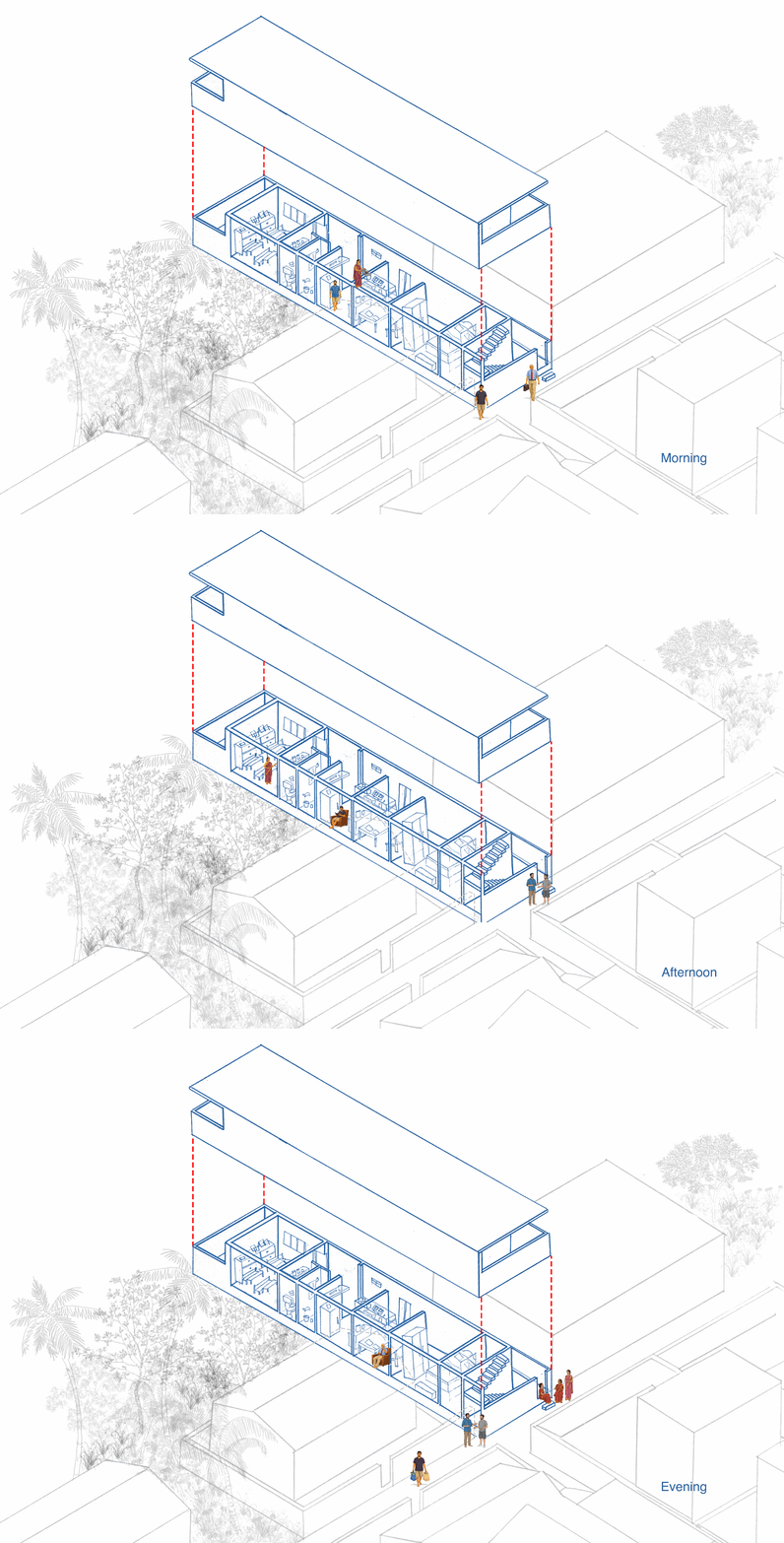
Routines of Everyday Life
Everyday life in Rajesh’s house is shaped by work schedules, household responsibilities, and neighbourhood interaction, showing how domestic space supports preparation, rest, and social exchange throughout the day.
Incremental Adaptation Across Five Houses

The settlement reveals a gradual typological transformation shaped by livelihoods and mobility. What began as uniform single-storey units expanded horizontally during periods of intensified labour and production. As families sought greater separation between domestic life and work, ground plus one structures emerged, while mixed-use buildings developed when weaving declined or ceased.
Over time, the housing typology moved beyond purely residential use to become hybrid, layered, and temporal. It reflects the long-term effects of environmental displacement, economic fluctuations, and shifting social aspirations.
Not all families continued in weaving. Education, migration, institutional employment, and religious networks opened alternative pathways, particularly for younger generations.
These occupational transitions directly reshaped domestic space. Rooms once occupied by looms were converted into classrooms, storage areas, or rental units, while upper floors replaced ground-level workspaces. Gradually, productive and domestic zones became spatially separated. The house thus emerges as a material record of adaptation, aspiration, and exit, rather than continuity alone.