Meantime 1 : Adaptations and Extensions
click on the numbers or highlighted houses for details
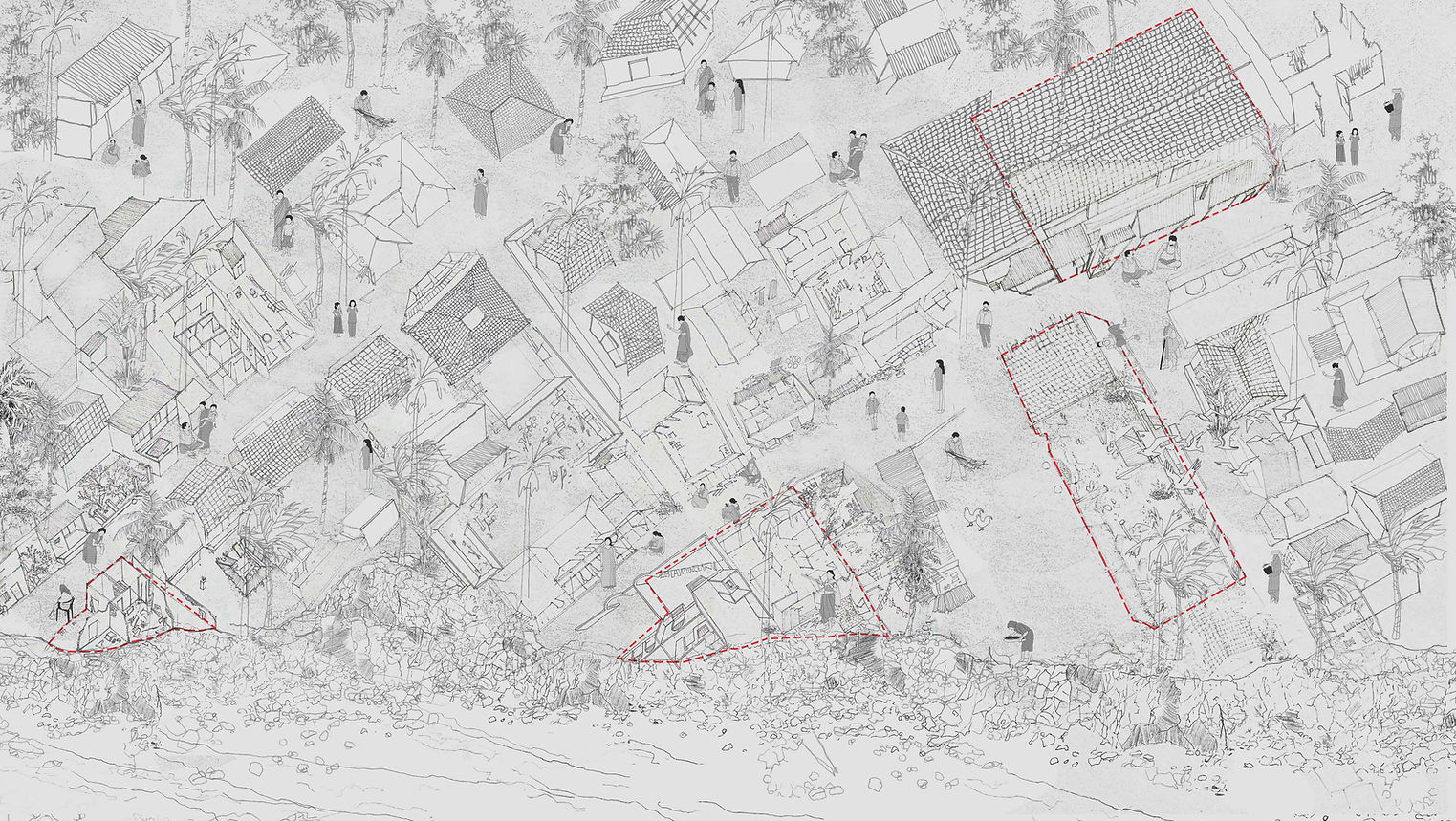
click on the numbers or highlighted houses for details
What may appear unstable to an outsider feels familiar to those living along the coast. The sea advances and retreats. Cyclones return. These events are not treated as exceptions, but as part of a longer cycle. People speak of them with memory rather than alarm.
In Uppada, everyday life does not remain contained within the walls of the house. Much of it unfolds at the edges; on verandas, along the road, beside partially built or damaged structures. These spaces are not treated as secondary or leftover; they are where people spend most of their time. Sitting, talking, sorting fishing materials, drying clothes, resting in the shade, these activities take place outside as a matter of habit, not choice
.After the cyclone, many houses became smaller in practice than they were on paper. Some lost rooms, some lost roofs, some simply became uncomfortable to occupy for long hours due to heat and lack of ventilation. As a result, domestic life naturally moved outward. The veranda began to function as a room. The road, meant for movement, slowly became a place to pause. These spaces are neither fully private nor fully public. Their use is understood through routine and familiarity, shaped by long-term coexistence rather than rules or boundaries.
The building’s broken elements were reused with care. Door frames that no longer held doors became points to tie ropes for drying fish. During the day, the space functioned as a working area. By evening, it changed again. People gathered near it, sitting both inside the broken structure and along the road outside.
Conversations moved easily across these spaces. The boundary between inside and outside no longer mattered. There was no attempt to restore the building to its original form, nor any sense of loss attached to its condition. Instead, the structure was accepted for what it had become. Plants grew out of cracks, birds nested within shaded corners, insects settled along damp surfaces.
Here, difficulty is not sudden. It is expected. People adjust their routines, their spaces, and even their relationships around it. Houses are repaired, reused, left open, or partly abandoned.