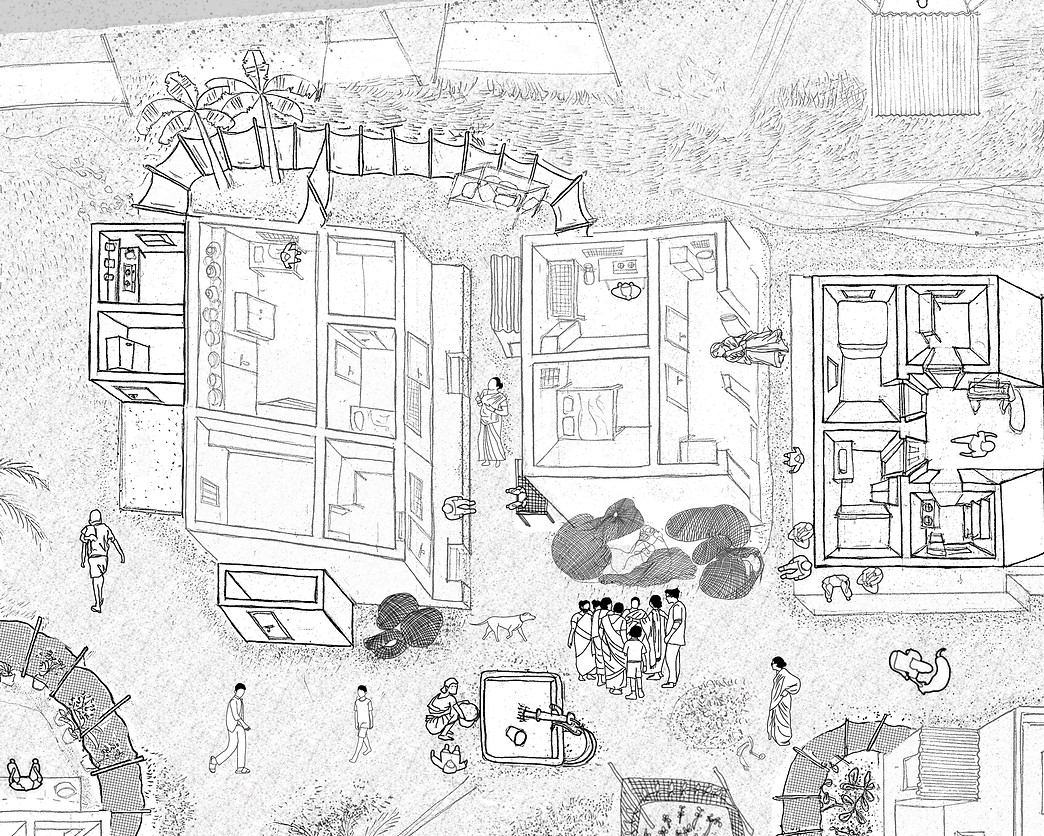
Fence for security
New type with separate kitchen
Extended resting area
Extended additional storage
Fishing net create invisible boundaries
Extensions As Invisible Boundaries
At the edge of the common courtyard stands a large house belonging to a small boat owner. It is divided into two parts between two brothers. The smaller portion originally occupied by the younger brother consists of a single multifunctional room and a kitchen with a store room extending into the common courtyard. Since the younger brother moved away, this part of the house remains largely unoccupied.
The elder brother occupies the larger portion of the house, which comprises a living room, a multifunctional room, a store room, a verandah, and a kitchen. Several of these spaces are later additions. The kitchen was constructed as an extension and did not form part of the original house, while the toilet was added beside the house at a later stage. The backyard is enclosed by a fence to maintain privacy and security, as it directly faces the main road. This enclosed edge is primarily used for storage. Further expansion into the common courtyard occurs not through built walls, but through objects. A handpump placed at the edge of the house projects domestic activity outward into shared space. During the afternoon, the woman of the household washes clothes and utensils beside it. A cot placed outside the house serves as a resting surface and, at times, as a platform for drying utensils.
Together, these additions and everyday objects establish an invisible boundary around the house. Without formal enclosures, they create a clear perception of ownership and regulate who can occupy or use the surrounding space. The dwellings are produced incrementally, through extensions and use, rather than through a single, fixed form.
At the outer edge of the settlement, a statue of a politician marks a social space. Surrounded by seating, it becomes active in the evening hours, when men gather to rest and talk. Both sites demonstrate how built form, objects, and daily practices together define the limits of private and communal life within the settlement.