

Settlement Studies: Uppada, Andhra Pradesh
The Shifting Edge
Studio Co-ordinator:
Prasad Khanolkar, Rohit Mujumdar, Dipti Bhaindarkar, Richa shah
Svapnil Pithava and Esha Waingankar
The settlement study course was conducted in Uppada,Uppada is a coastal village in Kothapalli mandal of Kakinada district, Andhra Pradesh, located along the Bay of Bengal. Its settlement pattern is closely tied to the shoreline, with fishing and small-scale handloom weaving forming the primary livelihoods.

This study examines Uppada to understand how a coastal settlement adapts to recurring cyclones and long-term land erosion, and how these environmental pressures influence livelihoods, socio-cultural practices, and collective life. The village comprises weaving, fishing, and farming communities, including Devang and Pattusali weavers, Vada Balija fishers, and Kapu farmers. Uppada experiences a tropical coastal climate with high humidity and seasonal monsoon rainfall, making it vulnerable to cyclonic activity. A major cyclone in 1977 caused extensive loss of life and housing, while long-term erosion has resulted in significant land loss over recent decades.
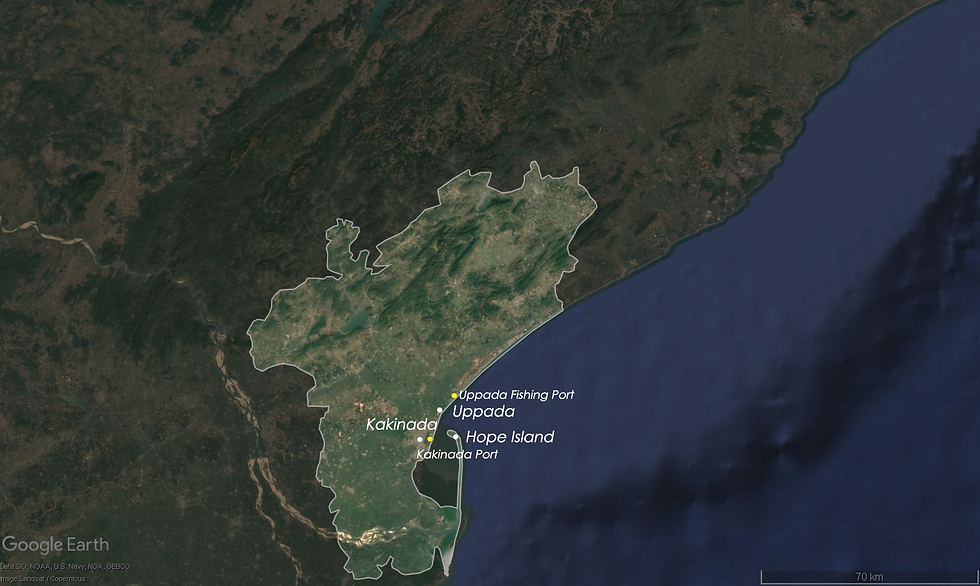
We focused our studies on the 10 clusters ,which were spread across uppada,stories and narratives were collected and documentation was done in the form of narrative drawings. Amidst a landscape where calamities are a frequent event,how does life get shaped?
Intent was to create drawings not just in form of plans and sections but also how these drawings narrate stories,so each group had their own way of drawing the stories out of the clusters. Stories were further filtered from the weaving and fishing community.
Overview of the weaving community :
Growing houses in a waning economy
How has environmental displacement and shifting economic conditions reshaped the weavers’ community and its built form over time?
The drawing begins by questioning how a government-planned rehabilitation settlement, conceived as a uniform and stable solution, gradually evolved into an adaptive built fabric. Rather than reading the houses as finished products, they are understood as timelines, where each extension, added floor, or repurposed room registers a response to shifting environmental, economic, and social conditions.
This settlement did not emerge through processes of urban expansion, but through environmental crises. In the early 1990s, repeated cyclones along the Andhra coast displaced weaving communities. What began as a temporary measure of relocation slowly consolidated into a permanent inland settlement.
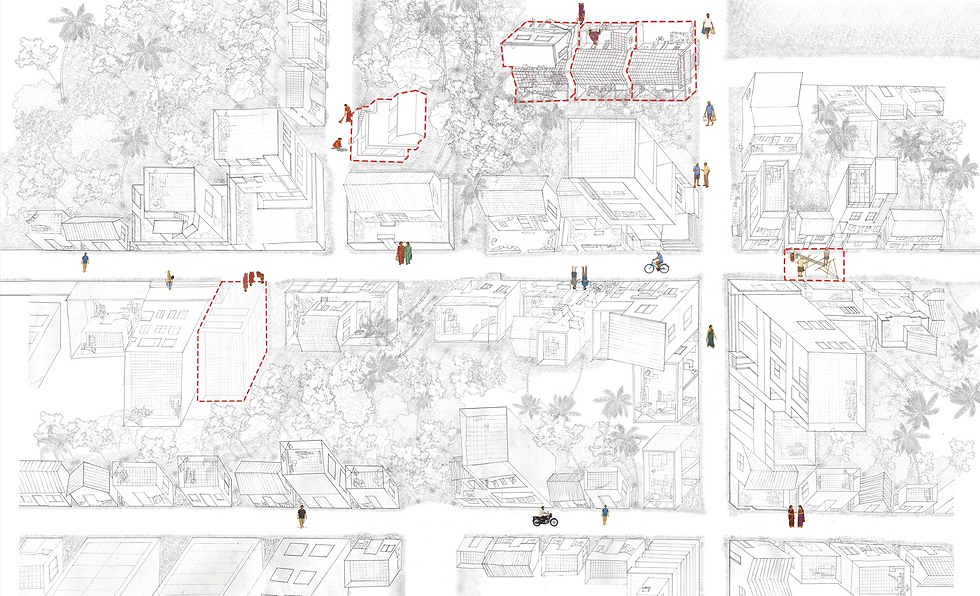
In 1995, under the N. T. Rama Rao government, the site was formalised as a Shelter and Services Rehabilitation Scheme colony for the Backward Classes – Group B (BC-B) weaving community. Eighty housing plots were laid out on formerly agricultural land acquired from local farmers and allotted equally among five weaving castes—Devang, Senapat, Padmashali, Pathshali, and Kakibathula. Each family received a three-cent plot measuring approximately 12.9 metres by 9 metres.
As weaving shifted fully into the domestic realm and became a year-round occupation, the settlement began to transform incrementally, house by house. Over time, the built fabric came to be shaped less by the original planning framework and more by livelihood practices, labour patterns, and long-term adaptation. Through continuous processes of extension, modification, and reuse, the settlement reveals itself not as a fixed outcome, but as an evolving spatial record of everyday survival and resilience.
Of Commons & Enclosures :
How do environmental and climatic changes alter occupations, and in turn reshape private and communal life in the fishing settlement, in Uppada?
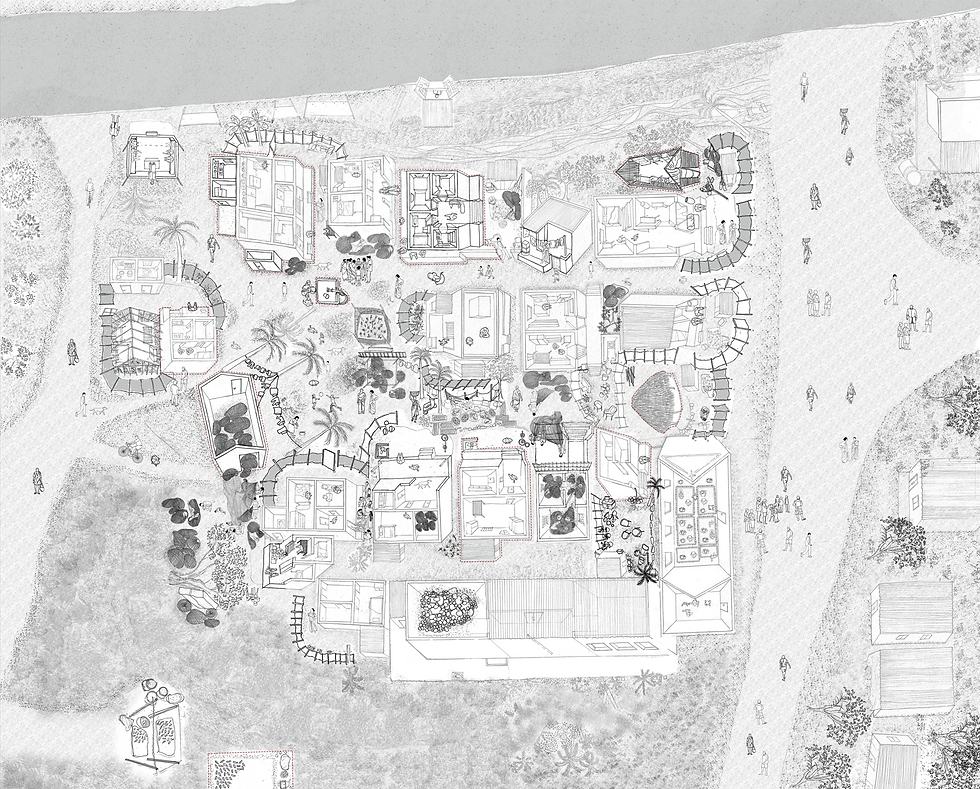
The drawing explores the fishing settlement through the presence of boundaries that are not formally built, but remain spatially operative. These boundaries are produced through everyday elements like handpumps, unused fishing nets, patches of vegetation, and objects in daily use; each marks zones of access, movement, and control without the need for permanent enclosure. Alongside these, certain houses are defined by rigid fences, introduced in response to specific needs of privacy, security, or ownership. The coexistence of these different boundary types is closely tied to livelihood patterns and the temporal routines they generate.
As fishing yields have declined due to environmental changes, the settlement has undergone a visible occupational shift. Many fishermen have moved into alternative forms of labour such as auto driving and construction work. With the growth of aquaculture industries, women’s work has also shifted, from fish vending within the settlement to shift-based labour in aqua-processing units, where prawns are segregated in Sandhya Aqua.
Through these transformations, the drawing traces how changing economies reorganize space. Invisible boundaries persist, adapt, or dissolve, while fixed enclosures appear in select conditions. The drawing narrates the stories of families, relationships, livelihoods, economies, and how they shape the private and communal life of the settlement.
An Everyday:
The house is located along the coast of Uppada. It is a mud house with plaster cladding, covered by a thatch roof and tarpaulin sheets. The main house is divided into five rooms, including two kitchens called Vanta Gadi, which are mainly used during the rainy season. There are two Padaka Gadi (bedrooms) where the family rests, and these rooms also serve as storage spaces. There is a Devuni Gadi (pooja room) where the idols they worship are kept. Alongside these spaces is a verandah-like area known as the Vasara.
The house also has an extension which was built later where her other son stays, which includes a Padaka Gadi (bedroom) and an Ugraanamu (storage space).
In addition to the built rooms, the family uses the Peradu (backyard) and the Praganam (front courtyard) extensively. These are the spaces where they spend most of their time during the day.
Ravi Pratap and his family live in this house, though they are not the owners; it is a rented house. Their original home was washed away in a cyclone. Ravi and Sarda have two sons who are both fishermen and their wives work in prawn processing factories. Each of them has two children who are currently studying in school.

The house also has an extension which was built later where her other son stays, which includes a Padaka Gadi (bedroom) and an Ugraanamu (storage space).
In addition to the built rooms, the family uses the Peradu (backyard) and the Praganam (front courtyard) extensively. These are the spaces where they spend most of their time during the day.
Ravi Pratap and his family live in this house, though they are not the owners; it is a rented house. Their original home was washed away in a cyclone. Ravi and Sarda have two sons who are both fishermen and their wives work in prawn processing factories. Each of them has two children who are currently studying in school.
The study of Uppada foregrounds the built environment not as a finished object or a static response, but as an ongoing process shaped by climate, livelihood, memory, and negotiation. The settlement demonstrates how everyday life continues within conditions of uncertainty, where erosion, cyclones, and economic shifts are neither external shocks nor isolated events, but part of a lived continuum. The making of space here is inseparable from routine adaptation, incremental repair, and the flexible reuse of structures. What kinds of spatial frameworks can support change over time without demanding restoration to an ideal or original state?The inquiry, then, is not only how to intervene in vulnerable contexts, but how to learn from them by recognising existing practices, quiet forms of resistance, and ways of living that persist at the edge without seeking resolution.


Comments