

Building Systems: Old Kabristan Road, Jogeshwari
Studio Co-ordinators : Milind Mahale, Dipti Bhaindarkar, Saurabh Barde, Abhijit Ekbote
Aditi Bhatt
The project is located along Old Kabrastan Road in Jogeshwari East, a narrow residential commercial street defined by one-storey, self-built houses and small shops. The street edge is highly active, with daily life extending into the public realm through plinths, steps, shaded verandahs, and temporary market setups. These elements create a continuous overlap between inside and outside, where domestic activities, informal work, reading, and social interaction occur throughout the day. Elderly residents often occupy the steps as informal seating areas, while women and men use the street edge for household work, conversation, and small-scale economic activity.
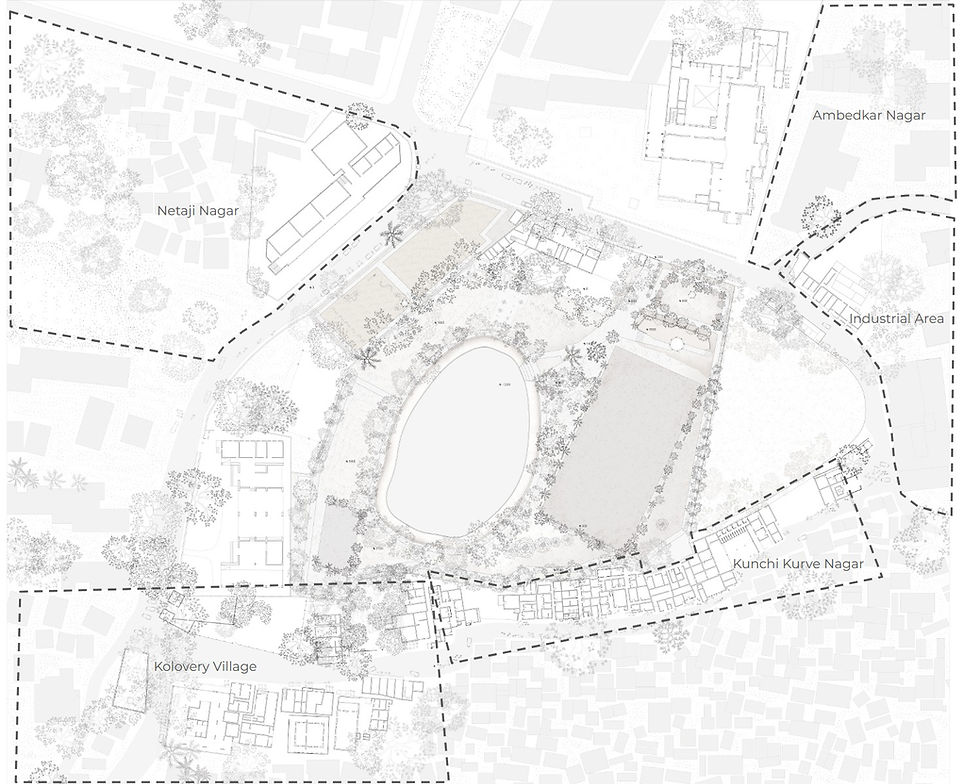
At the centre of this dense neighbourhood lies an open playground maintained by the Municipal Corporation of Greater Mumbai (MCGM). Measuring approximately 3,500 square metres, it is one of the few open spaces in the area. Its longer edge runs along Old Kabrastan Road, making it directly accessible from the street. Dense vegetation lines the perimeter of the ground, providing shade and forming a buffer between the open space and the surrounding built fabric. The playground functions as a shared community anchor, accommodating play, gathering, movement, and pause within an otherwise compressed urban environment.
We began the project with a detailed documentation of the site and its surroundings. This included mapping existing trees and vegetation and identifying species commonly found in the region using an online documentation server called Tree Sense Us. This database helped us understand the vegetation on site categorising them as per their leaf types and other characteristics. Understanding the distribution of shaded and exposed areas across the day helped establish relationships between vegetation, microclimate, and patterns of use. Particular attention was given to how the vegetated edges of the playground influence comfort levels and define spatial thresholds. We also mapped the site through images and tried to recreate the 3 dimensional site digitally using a software called Mapillary.
Mapillary Data Tree Sense Us Data Learning to use a Total Station Data from Total Station
The site’s slight terrain variation was also carefully studied. Changes in levels across the ground informed our understanding of surface runoff, water movement, and opportunities for water collection. To document this accurately, we were introduced to surveying instruments such as the total station and trained in generating and reading contour lines. These tools allowed us to record levels, slopes, and gradients with precision, forming the basis for design decisions related to land remoulding, reshaping, and water harvesting.
This documentation phase established a grounded understanding of the site as a combination of physical, environmental, and social conditions rather than a neutral plot.

Key Plan & Site Sections
Site Study
The design process was structured around the idea of resources as primary drivers of form and space. We explored resources such as land, water, wind, and solar energy, using them to guide architectural decisions rather than treating them as secondary considerations. Strategies included shaping land to manage water flow, integrating rainwater harvesting into roof and surface systems, reusing materials informed by local construction practices, and organising spaces to support passive ventilation and daylighting.
Architectural form was developed through the integration of these systems. Structure, enclosure, circulation, and environmental strategies were conceived as interdependent, allowing the building to function as a coordinated system. In this approach, the system informs the form, and the form performs as a system.
Calculations and working for various Resource Systems
Within this framework, the community library was conceived as four overlapping conditions: a Library for Play, a Library for Knowledge, a Library for Work, and a Library for Care. These conditions were embedded within the environmental and spatial logic of the building. Spaces for play were aligned with shaded outdoor areas and visual connections to the playground. Knowledge spaces were organised to allow controlled daylight and acoustic comfort. Work-related spaces supported flexible use and environmental efficiency, while spaces of care were located in thermally stable and quieter zones.
Through this process, we explored how architectural form can emerge from the integration of environmental systems, site conditions, and community use, resulting in a design approach where spatial organisation, performance, and experience are developed together.
Aditi Bhatt Juhi Iyengar Sukhad Sutar Upanshu Sakhala Manas Sontakke Upamanyu Sensharma Mahi Dattani Rutuja Patil
Designs


Comments