

Form, Space and Experience
Updated: Feb 11
Studio Co-ordinators: Vastavikta Bhagat, Tamal Mitra, Kausik Mukhopadhyay, Prasad Shetty, Apurva Talpade
Saanvi Kulkarni
Contributions: Shardul Ayare, Sanskruti Chavan, Mrudula Chorage, Om Dandekar, Vvrishank Jamaiyar, Vriddhi Joshi, Twisha Motghare, Janhavi Ruia
The first-year Form, Space, and Experience module evolved as an extension of the Orientation, aimed at expanding our understanding of spatial manipulation through various forms of play and creation. Through a multi-step process, we developed our initial ideas further, giving them forms as installations and costumes.
The first few weeks involved reworking our individual drawings into group installations or costumes. Based on feedback from the faculty over multiple iterations, groups were formed based on common underlying themes. The groups wrote collective scripts that integrated their individual perspectives into a singular thematic text.
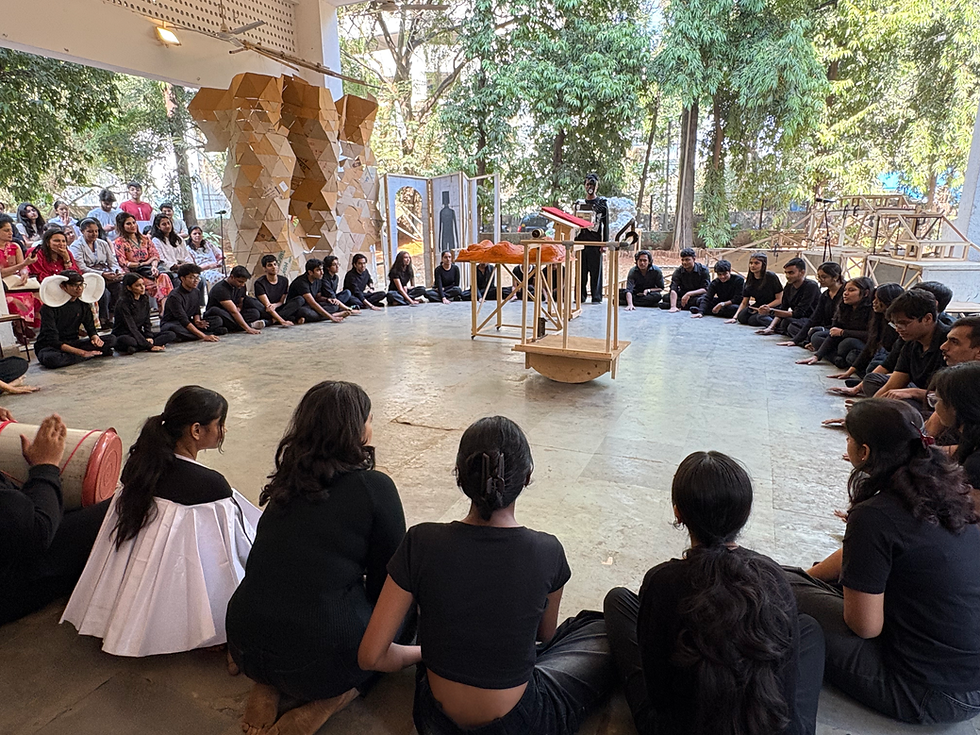
Following this, the processes of making and rehearsing progressed side-by-side. The costumes were altered based on everyone’s characters, roles, and interactions. By the end, the play culminated into an eight-part showcase of the shifting dynamics of human perception. Titled ‘A Cat Darted Across the Street, Stopping Just Long Enough to Glance at Me’, the overall performance challenged notions of spatial manipulation and theatre as a form of expression. The individual groups had their own insights into the unique processes that led them to their final outcomes.
Bodies - Vriddhi Joshi
Group: Anupama Chandak, Vriddhi Joshi, Jehan Mistry, Manan Mistry, Hrithika Naik
We all started by working on texts related to bodies and their transformation. Eventually, we got to writing texts that detailed these changes and the ways that they manifested themselves in physical forms. Our models followed these principles – Vriddhi created a dissected body, Jehan made a costume of a swollen body form, Hrithika designed a long, cape-like apparatus, Anupama’s prop helped her look for things, and Manan engineered massive ears that were intended to assist him in listening to small details.

Decay - Om Dandekar
Group: Om Dandekar, Teeyah Dutt, Sparrsh Hambardikar, Duhan Pahwa, Nidhi Patel
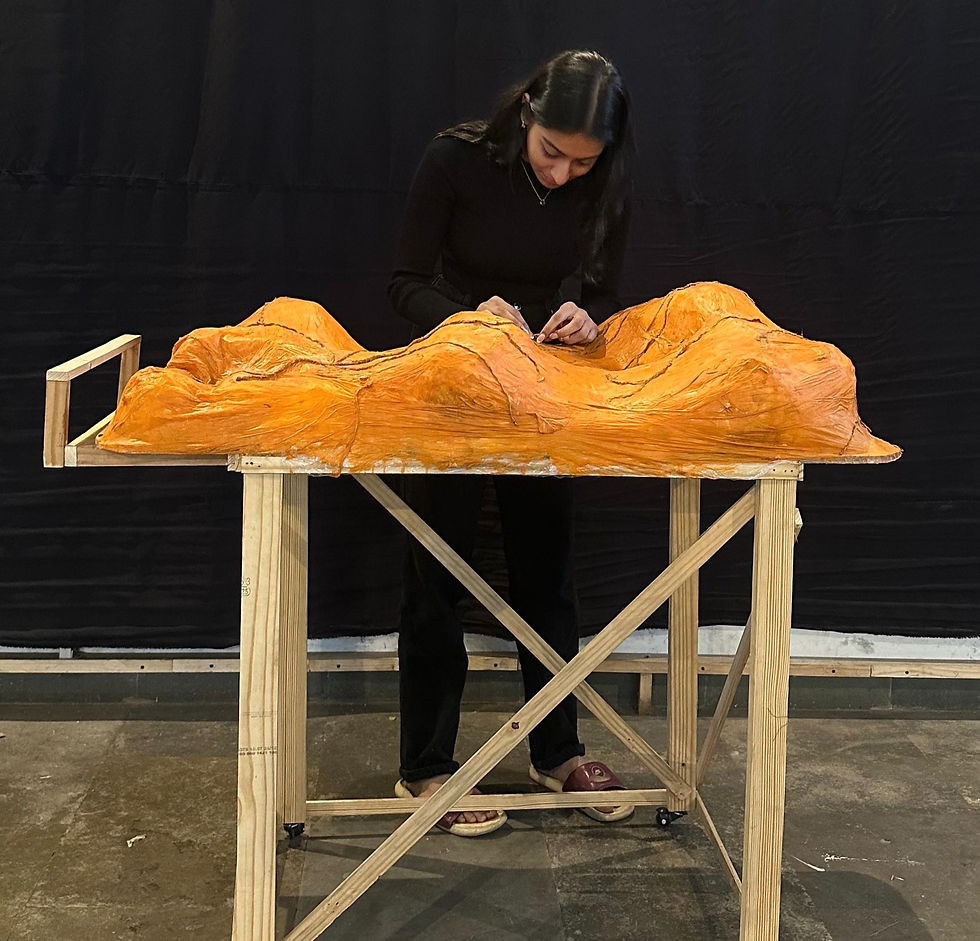
Arriving at our final ideas and drawings took many iterations. Personally, I started with a theoretical device to absorb noise and create a ‘silent’ city. This evolved into an environment of ‘sound decay’, and the rest of my teammates contributed to it with their own forms of decay as an overarching theme. For example, Sparrsh started with the sensation of floating and moved on to decay as a form, Nidhi worked with olfactory decay and smells, Teeyah explored vision decay, and Duhan worked with mold as a growing organism. As a group, we began by creating an ‘environment’ of decay, and designed a prop to fit our bodies and depict the overwhelming growth of decay. Our TAs assisted us through our final iterations and last stage of rehearsals.


Machines - Janhavi Ruia
Group: Arjun Ambre, Taabish Halai, Swara Hodawadekar, Adrita Ghosh, Janhavi Ruia
We started through ideas of different principles in Physics, and ended as a collective machine. The initial phases involved studies of inertia, the laws of motion, light and shadow, and propagation of sound. We built different singular machines centred around these topics. After this, we wrote texts based on our chosen phenomenon and curated a drawing together, which showed how we thought a machine would look if we were inside it.


Newton - Shardul Ayare
Group: Kavyatharshini Arumugam, Shardul Ayare, Saanvi Kulkarni, Ronak Shethji, Kushal Parwatkar, Rishabh Vazir
After understanding our topics, we were assigned to specific groups, where we were asked to create drawings of a character experiencing the produced space after a series of drawings. After the faculty’s inputs, we started making our costumes. We were introduced to our TAs, who for a week helped and directed us through our process. They guided us through their own experience during their orientation module – for me, they aided with material work for my costume, and with sourcing components and arranging them together. After this, we had a little over a week to prepare for the actual act. Most of our props were completed, so our main focus shifted to the rehearsals, until the day of the performance.


Space - Mrudula Chorage
Group: Mrudula Chorage, Diksha Dhuri, Jay Gediya, Tejas Girniwale, Jaimin Mistry, Krishna Sondagar
Our group observed the concept of spaces, and the various ways in which they can be observed, understood, and analysed. Each member approached space uniquely – Diksha examined it from a ‘corner’ viewpoint, in fragments and patchworks. Mrudula analysed space statistically, by observing materials, proportions, and data. Jay approached space mathematically, through a study of angles, in a grid format. While Krishna imagined it in a dreamy, abstract manner. Jaimin viewed space from an elevated perspective, offering an overall layout, and Tejas carefully documented these aspects. As the module progressed, we worked together to transform our individual drawings and written ideas into physical props. Through continuous discussions, experimentation, and refinement, these props gradually evolved. With the constant guidance, feedback, and encouragement of our TAs – Samkit, Aayush, Avi, and Heeya – we were able to refine our concepts and successfully bring our ideas to their final stage.


Crowds - Twisha Motghare
Group: Hiranshe Jariwala, Ved Keer, Nishka Mehta, Twisha Motghare, Ashmi Shah
We started as a group because our individual drawings dealt with seeing things in distinct and different ways. We were instructed to observe a single phenomenon and describe it through perspectives in our texts. To be specific, Twisha saw through lenses, Nishka through fragments, Hiranshe saw stillness, Ashmi saw movement, and Ved was dealing with speed. We chose to observe a bazaar, and after going to Crawford we wrote our texts individually, and these evolved into descriptive drawings. From here, we moved on to group drawings, showcasing movements of people and how these overlaps create spaces and crowds. Our final props were developed through this central idea of a sense of multiplicity without using extra people in the actual performance.


Surfaces - Vvrishank Jamaiyar
Group: Poojan Bhansali, Vvrishank Jamaiyar, Yashita Lad, Bhagyashree Nivande, Samruddhi Yarzal
We started this module working individually with different ideas; with the elliptical motion of a pendulum, chemical reactions, multiple exposures using photographs. We later wrote texts, developing characters based on our drawings and works. We were grouped together and started developing our texts. The common factor in our work was growth and transformation and modules that joined together.
Based on this we continued developing our texts, and ended up with two of them, one describing the movement and the layering of light in multiple exposure photographs. The other being a song written in the form of chemical and mathematical equations and formulae. Following this we moved to making our models and structures. Our group moved to using a fish scale like shape as a module and building from there. However the structure which was supposed to stand on its own, did not do so. This was because of the material we were using as well as our method of joining it. After this we changed our method of joining the units together and made a small scale model of how it would work.
Once we achieved this, we switched materials from cartridge paper to cardboard/corrugated board. This newer material was stronger and could stand on its own even on a larger scale. Unfortunately when we began to build a surface using these units to show modular growth, only the first few layers would by itself, and the upper layers would fall over and the glue also wouldn't hold the weight, as well as taking a lot of time.
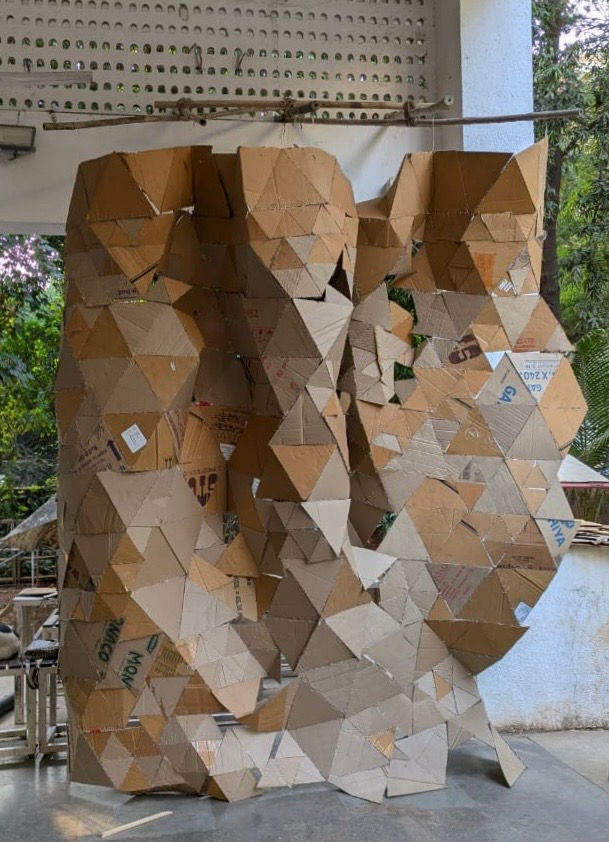
By this time our TAs had joined us. Together we tried many different methods and finally settled on making a bamboo frame, attaching it to the top and then suspending our structure from the frame and building from the top down. We switched to stitching the units together using nylon string. We continued working and soon our structure was complete. Its final form was a structure made of tessellating triangular modular units of different sizes that joined each other on the edges, with the entire structure being suspended from a bamboo frame. This module taught me a lot about patience and resilience and resolving problems that arise, as well as different materials and ways of joining them together and thinking out of the box. This also gave us an opportunity to interact with our seniors in the form of TAs. They made the process easier and more enjoyable with their unique insights and their help.

Ramps - Sanskruti Chavan
Group: Sanskruti Chavan, Mansi Deshmukh, Anagha Lakhan, Riya Rathod, Tanishka Raut
My individual drawings were inspired by a Physics textbook, aiming to capture the idea and sensation of floating. I derived from the experience of swinging – drawing panels that showed how I see from that perspective. I spent hours on the swing to get the view just right, iterating my drawings based on reviews from the faculty. The group formed later due to similar ideas of spaces, movement, and being trapped. Our ideas evolved into a cohesive project through multiple iterations – a rollercoaster of reviews and implementation. We worked on our texts, compiled them, and figured out how to interconnect our topics. One of the challenges we faced was agreeing on ideas – not everyone was always on the same page, and we had to navigate that. There were times when we were clueless on how to move forward, tried new approaches, and faced setbacks. Later, we moved on to building – experimenting with new skills such as woodwork, drilling, and controlling a space using just our bodies and our voices. Our TAs guided us through this process, offered insights, and provided a larger understanding of space.



Comments