

Community And Builtform
Studio Co-ordinator: Prasad Khanolkar, Rohit Mujumdar, Anuj Daga, Richa shah
Lavanya Parab
In this studio, we tried to understand the relationship between different spaces in the urban context by exploring urban neighbourhoods as spatial configurations formed by multiple communities operating at different scales. Through this process, we began to see the city not only as a physical environment made of buildings, roads, and open spaces, but as a lived space shaped by everyday activities, social interactions, and cultural practices. We focused on how people use space in their daily lives and how these uses gradually shape the built form of the city. We observed that the cultural practices of different communities influence how spaces are occupied, shared, modified, and sometimes contested.
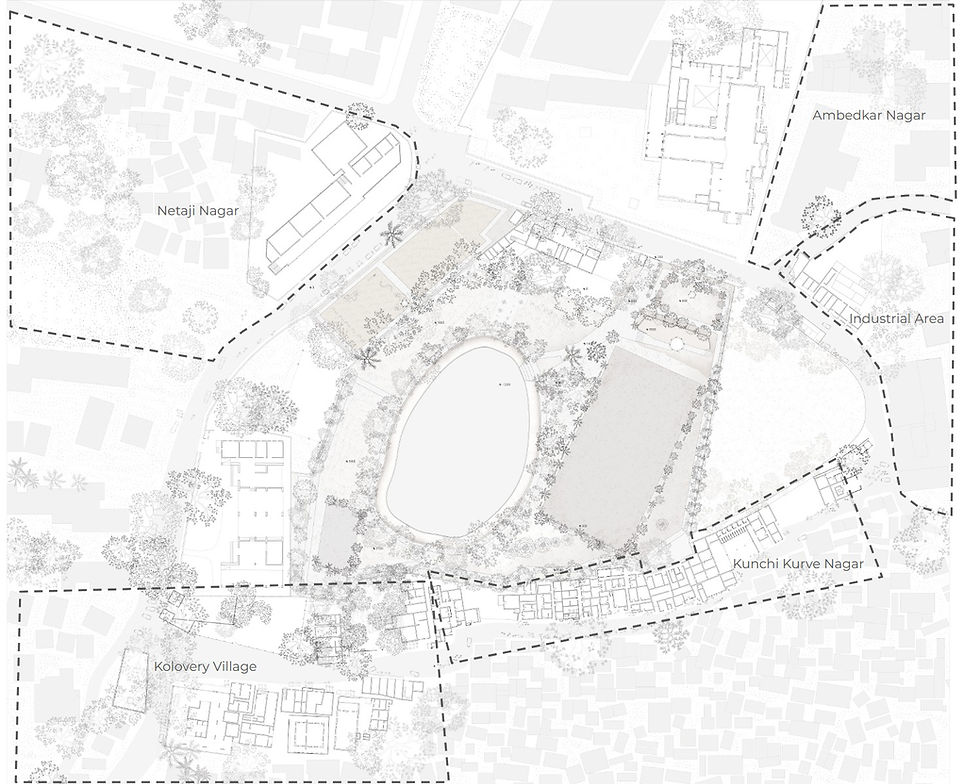
Over time, we noticed that certain areas become associated with specific activities or groups, while others remain more neutral or flexible. This helped us understand that space is constantly changing and responding to the needs, habits, and values of the people using it.
The studio began with our understanding of the dynamics of the site, Joseph Baptista Park located in Kalina, Santacruz. The park is surrounded by a variety of communities and institutions, including residential areas, religious institutions, educational buildings, and healthcare facilities. We studied how each of these has its own routines, timings, and spatial requirements, which influence how the park is used throughout the day. Along with this diversity, we also observed the issues and conflicts within the community. These tensions are reflected in the way different groups occupy certain parts of the park, avoid other areas, or establish informal ownership over specific zones.
Through studying these conflicts, we explored how the park still functions as a common ground despite differences among communities. Even though there are divisions and boundaries, we saw how the park continues to bring people together through shared activities. We also studied the history of the park and how its role within the neighbourhood has changed over time. This helped us understand how past developments, changing users, and shifting priorities have shaped the park’s present condition and everyday life.
To understand the whole community we took interviews of the community and tried to understand their occupations, religion, ownership, etc.

Another important aspect of the studio for us was understanding how the park supports cultural practices such as festivals, informal gatherings, exercise, play, and daily social interactions. We observed how these activities temporarily change the character of the park and affect movement, density, and use of space. Our design development began with mapping these activities, conflicts, and relationships and responding to them through spatial strategies. Understanding appropriate programs was important to us, especially since ideas of ownership, access, and belonging needed to be handled carefully.
While responding to the same site, we explored different design approaches focusing on boundary conditions with the surroundings that respond to the institutions around the park, also the existing biases amongst the communities.Certain areas around the central lake and movement paths connecting different edges of the park became sites that allowed interaction of different communities. Although the context remained the same, our proposal developed its own identity based on how we interpreted community relationships, movement patterns, and shared spaces.


Comments