

Settlement Studies - Khijadiya, Jamnagar
- Liesha Patkar, Aaradhya Kulkarni
- Feb 22, 2025
- 6 min read
Updated: Feb 10
Studio Co-ordinators: Apurva Talpade, Kausik Mukhopadhyay, Prasad Shetty, Tamal Mitra
Liesha Patkar, Aaradhya Kulkarni
Our week in Khijadiya, a village near Jamnagar in Gujarat, was meant to understand how people live, work, and build in relation to their environment. The village is small, but it carries layers of agriculture, craft, and small industries, all of which influence the way houses, streets, and open spaces are organized. We started by walking through the village in small groups, slowly making our way to its edges. On one side, the walk ended at fields and animal farms; on the other, it opened into the lake where flamingos gathered. This movement across the settlement revealed how Khijadiya sits between land and water, and how this setting supports its everyday routines.
Along the way, we stepped into schools, temples, cow sheds, and homes. We saw mandaps set up for gatherings, small factories running alongside living quarters, and courtyards alive with daily work. Each stop unfolded into conversations with children eager to talk after school, women shaping dough in courtyards, farmers feeding their cattle, and shopkeepers balancing accounts in shaded thresholds. Rather than surveying buildings, we immersed ourselves in the rhythm of the place, where life, work, and space constantly overlap.
What struck us most was how rarely spaces here serve a single purpose. Work enters the home, animals are kept close to living areas, and public life seeps into streets and chowks. A threshold shaded by a bamboo mat becomes a place to pause and talk, a courtyard transforms from a domestic enclosure into a site of production, and the edge of one house opens naturally into a shared space for neighbours.
This initial exploration became the lens through which we began to ask larger questions how livelihoods and the environment shape the built fabric, how people adapt and extend their spaces, and how the identity of a village like Khijadiya lies as much in its everyday routines as in its physical form.
After the first day of exploration, we divided into smaller groups to study the village through different lenses - mapping, housing, landscape, and economy. Each focus became a means of documenting a specific aspect of Khijadiya while contributing to a shared understanding of the whole.
The mapping teams prepared proportionate plans of the settlement, with smaller subgroups working on different stretches of streets. Roof profiles, alignments, and open nodes were carefully recorded, gradually piecing together the spatial organization of the village. Parallel to this, others spent extended hours in selected homes, sketching layouts, sections, and elevations while observing how families used their spaces through the day.
These studies revealed how domestic life, livelihood, and storage constantly overlapped. Courtyards doubled as drying yards, terraces stored fodder and grain, and thresholds became sites for work and exchange. Nothing was entirely private and each space seemed to hold a flexible role within the life of the household.

While the built fabric was being documented, another set of observations extended outward, tracing Khijadiya’s relationship with its landscape. The fields, grazing grounds, and the lake formed a continuous landscape of sustenance. We documented the shifting light over the wetlands, the soft boundary between farmland and built edge, and the presence of migratory flamingos that mark the rhythm of the seasonal ecological systems that hold the settlement in place. Conversations with residents about their occupations, farming, animal husbandry, pottery, small workshops, or home-based businesses, further revealed how the local economy is deeply intertwined with both house and landscape.
Our navigation through Khijadiya’s narrow lanes, courtyards, and thresholds slowly revealed the deeper character of the settlement. Inside the homes we entered, we traced the proportions of rooms, the sequence of spaces, and the way each area adapted to its inhabitants’ changing needs. Every drawing became a tool to understand the house as both a place of living and an infrastructure of livelihood.
Along one chowk lane, we came upon one of the oldest homes in the village - the Kumbhaar’s house. Here, the street itself had transformed into a continuous aangan or an open courtyard shared by two facing houses. Rows of wet pots sat on drying racks, heaps of freshly kneaded clay waited to be worked, and every surface bore the marks of repeated use. The street had become an extension of the home, a shared workspace where the entire lifecycle of a pot, from clay to vessel, unfolded in plain view. We sat with the potters, shared tea, and watched their hands move with the ease of habit. In that moment, we witnessed how life and livelihood were so connected in that environment.


Kumbhaar's House
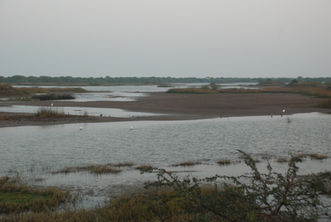
The landscape group stepped further out into the terrain. Khijadiya sits in a fluvial landscape, shaped by a river that has long since dried but left behind ponds, salty patches, and muddy textures that shift with each passing season. As we walked, the vastness began to assemble itself through a network of anchoring points like the water tank, the pond, the grazing fields which were markers that helped us trace that fluid ground. What became clear was the remarkable way these distinctly different terrains folded naturally into one another, forming quiet but bustling ecosystems that, in a way, nourished the village. The saline crust loosened into moist mud, which gradually gave way to grazing lands, which in turn opened toward the wetlands that held migratory birds, mainly flamingos that return year after year.
Moving entirely on foot allowed us to wholly experience these transitions. The terrain changed beneath our steps, its textures, sounds, and light shifting as we traversed from one land into another. In time, the landscape began to feel like another kind of home, shared by both people and the non-human life that sustained it, and closely linked to the everyday routines and needs of the village.



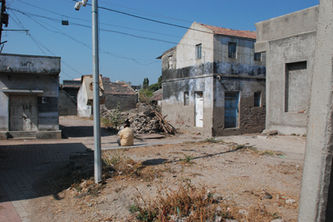


Within this larger landscape, the economic life of the village took shape. Agriculture, pottery, animal husbandry, small workshops, and home-based industries all drew from the land in their own ways.
Clay came from nearby pits, produce was dried in verandas, and mechanical parts were assembled in thresholds open to the street. Alongside this, nearly every family maintained a temple of their own, often devoted to the same goddess, and these shrines formed an intimate spiritual infrastructure running parallel to the economic one. Much of the income earned in distant cities by family members working outside the village was channeled back into the upkeep of these family temples. In moments of financial need, families would borrow from their own temple funds and later repay them, ensuring that money circulated internally and remained within the lineage. Donations for the construction of a particular temple, too, came almost exclusively from its own extended family.
Yet, despite this dense network of family-based religious spaces, there was an absence of rivalry. Instead, the temples stood as quiet affirmations of shared belief. Walking through the settlement, one could not help noticing the contrast between the worn, often weathered homes and the temples, many newly built, brightly painted, and maintained. These spaces reflected the strength of cultural values in Khijadiya, especially the deep devotion to Khodiyaar Ma, the kul-devi of the region. Belief in the presence of ‘evil forces’ was woven into daily life, and almost every house bore some form of trishul mark at its entrance, a sign meant to guard against the influence of spirits.





Temple House
By the end of the week, Khijadiya no longer felt like a place we were merely observing. It was a living system in which ecology, livelihood, and built form continually adjusted to one another. Nothing in the village is permanent, spaces shift with seasonal cycles, with patterns of migration, with work rhythms, and with the everyday needs of its residents. Within this constant movement, the home acts as the stable element, anchoring these shifts and holding them in a form that is both familiar and flexible. Through this, the village makes visible how closely life is woven into the land on which it depends.





Other House Studies
As we brought together all our observations, a clearer, more layered picture of Khijadiya began to take shape. The mapping exercises revealed its underlying structure, the housing studies showed its adaptability, the landscape explorations clarified its environmental context, and the economic observations highlighted the functions that sustain it. Seen together, these strands produced a coherent understanding of the settlement as interconnected parts of a system that operates through constant negotiation between people, work, and environment.



Image Gallery
Khijadiya, therefore, emerges as a place continually shaped by exchanges between land and livelihood, between craft and industry, between local practice and wider forms of mobility. Through all these shifts, the home remains the vessel that absorbs and accommodates change, a framework of permanence that enables the village to adapt over time while holding on to its core ways of living.



Comments