

Design for Biodiversity
Updated: Feb 11
Course Co-ordinator: Abhishek Khan
Sahil Sawant
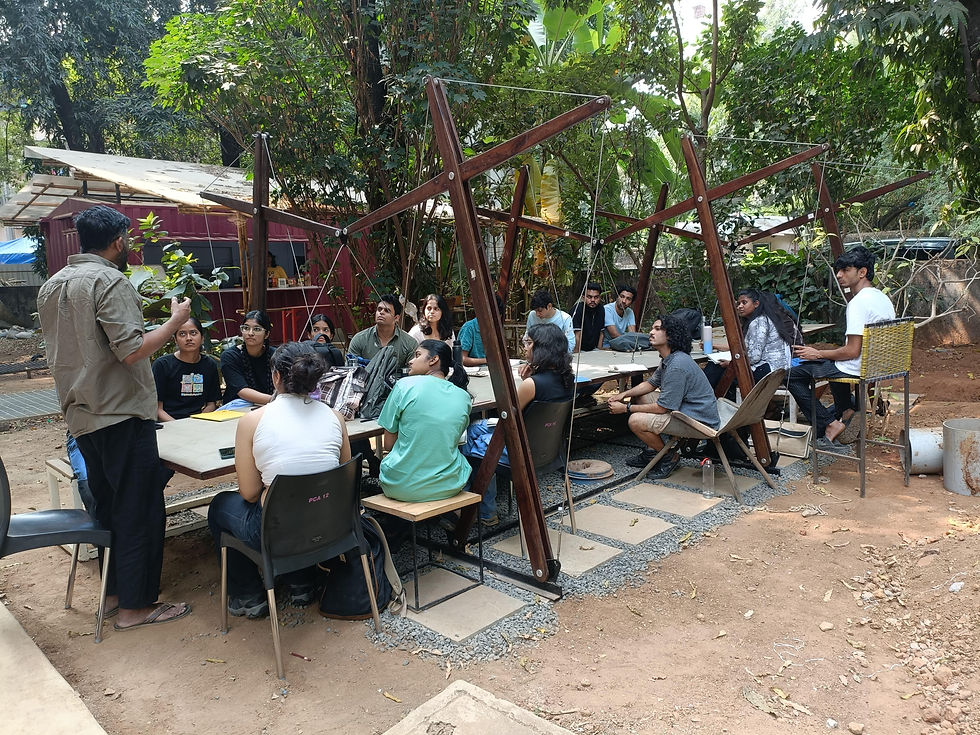
Across this elective, we questioned the foundations of human ecology. We discussed how we approach ecology with a mindset of dominance, altering ecosystems without regard for balance. From this analogy, we expanded our perspective, situating contemporary ecological thought within Earth’s vast timeline. We brainstormed with the evolving definitions of what is “natural” versus “artificial,” exploring how major forces such as scientific discovery, industrialization, colonialism, and even philosophy shaped humanity’s approach to ecology across eras.
Later, we studied controlled environments like permaculture gardens and indoor green spaces. Our ecological understandings deepened with two site visits. In Malad, close to Inorbit Mall, we explored a Miyawaki forest, an intensively grown, dense urban jungle mimicking natural layers. In Kharghar, Navi Mumbai, we visited a Cancer Hospital where a part of it was a Permaculture garden run by a woman, where nurturing ecology became a force for community empowerment.


On the final day we were analysing our college’s own ecological patterns—the flow of water, the direction of wind, the arc of sunlight. We were given a task to propose ten abstract interventions—bold, impractical, yet visionary ideas to bridge the gap between daily student life and ecological connection. Through sketches, diagrams, and collages, we imagined radical transformations.

The concept controls the ground’s microclimate through passive strategies, using trees, layered nets for natural debris and drainage, and soil recovery while supporting existing programs.

A library of ponds structures the site, using rainwater to form spaces for plants, play, and everyday social activity across a shared, open landscape.
This elective was more than academic; it became a lens to see how we relate to the planet. We emerged not only with a deeper understanding of ecological dynamics but also with a sense of personal responsibility. The elective reshaped are understanding of ecology and the way we design spaces by taking into account the multiple factors and layers of ecological understanding and perspectives.


Comments