

Real Stakes of Cinema Thinking
Updated: Feb 11
Course Co-cordinator: Shiraz Iqbal
Shreyash Bharmal
I have always been interested in storytelling and cinematography, analysing narratives, looking for hidden meanings, and studying compositions, camera angles, and the way scenes are framed. This interest is what pushed me towards choosing this elective. Many of the other students who had participated came from similar places of interest. Some were passionate about acting, others loved theatre, while a few enjoyed filming and editing videos in their own time.The elective became a shared space where ideas were exchanged , and openly discussed different perspectives regarding cinema and its making.

We began by tracing the origins of cinema, starting with Workers Leaving the Lumière Factory (1895), a short French black-and-white silent film directed by Louis Lumière and often regarded as the first true motion picture. We went on to watch several Lumière Brothers films to understand the earliest phase of filmmaking, silent, single-shot recordings with a stationary camera, capturing everyday moments as they unfolded.
From there, we moved to snippets of The Passion of Joan of Arc (1928), a French silent historical film directed by Carl Theodor Dreyer and based on the trial records of Joan of Arc. The film is considered a landmark in cinema, particularly for its direction, cinematography, and intense use of close-ups. Unlike earlier films, this period showed a clear evolution: moving cameras, varied angles, controlled lighting, and a stronger emotional language. Although still silent and black-and-white, these films were often accompanied by external music during screenings.
We then jumped to a much later example with snippets from The Swamp (2001) by Lucrecia Martel. Here, sound took centre stage. The film uses a dense,soundscape like cicadas, thunder, clinking ice, to create a sense of decay and unease. By amplifying off-screen sounds and often drowning out dialogue, Martel builds a claustrophobic, hyper-real atmosphere where sound, more than image, drives the narrative and creates a constant underlying tension.
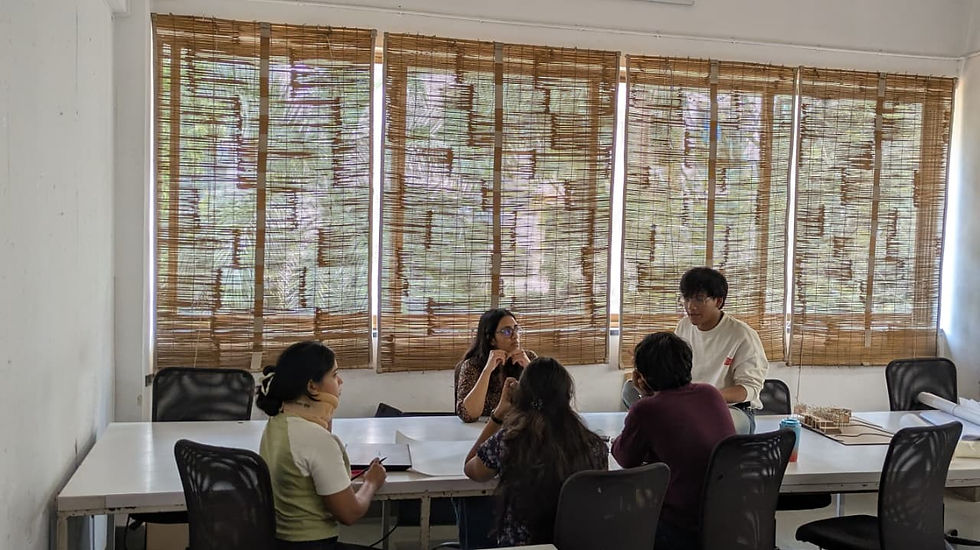

We screened and watched one film together every day, followed by a discussion. This process was important because each person noticed different details, moments, frames, sounds, or emotions that others might have missed. Through these conversations, the film opened up in new ways, as multiple perspectives and interpretations came together to build a deeper understanding. After the discussions, we translated our readings of the film into diagrams, using them to visually map our interpretations and insights.
We also watched a few documentaries on the Israel–Palestine conflict, each presenting a different perspective and approach to documentation. What stood out to me was how varied the methods of storytelling were. One of the documentaries used animation and CGI to imagine an alternate reality, what life might have looked like in the absence of conflict. I found this approach especially unique, as it moved away from conventional documentary techniques and used visual speculation to communicate emotion, loss, and possibility in a powerful way.

In the last two days, we decided to make a short film of our own. The idea was for each of us to record small clips from our everyday lives and then stitch them together, trying to find meaning and a narrative within them. To bring all these different fragments together, we needed a common thread, and we settled on the idea of the mundane—something universal and easy to relate to. The final short film felt like a culmination of everything we had watched and discussed throughout the elective. Overall, the elective was genuinely fun and has subtly but significantly changed the way I now look at films.
Link to the short film can be found here.


Comments